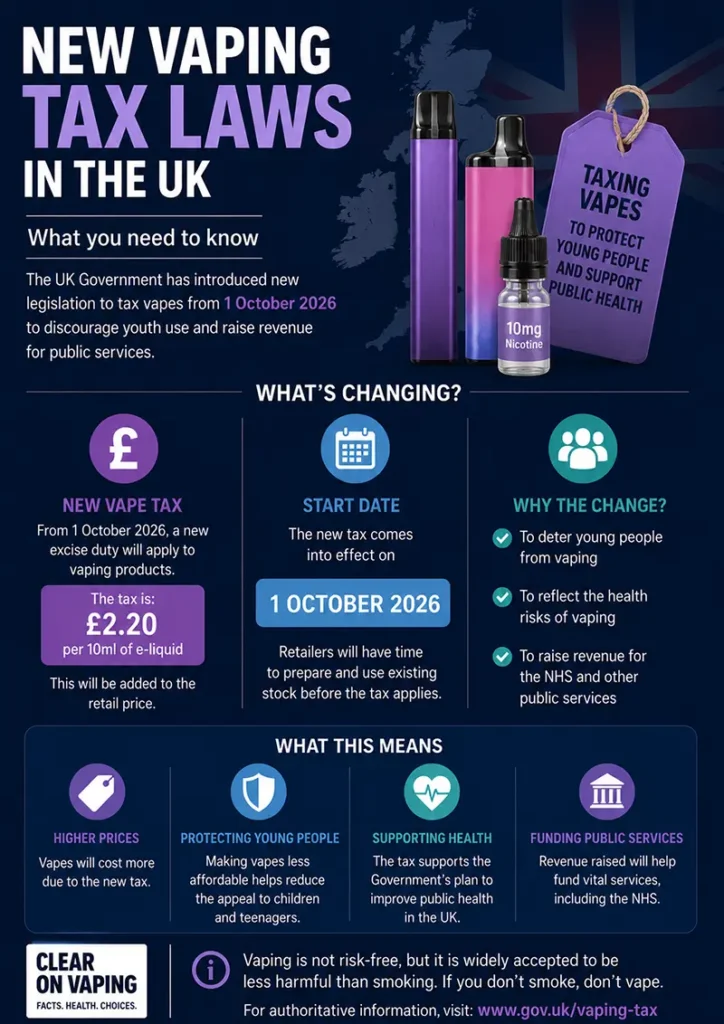
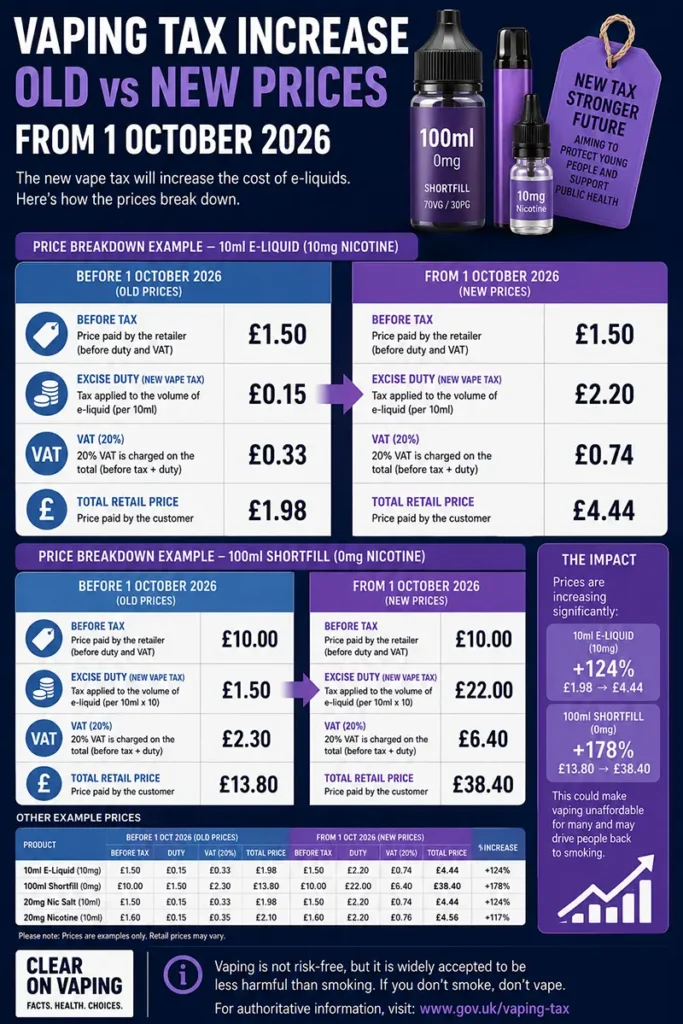
The Vaping Products Duty will start on 1 October 2026. From that date, every bottle of e-liquid sold in the UK will face a £2.20 tax per 10ml, whether you use nic salts or shortfills. This will affect pricing, stock levels, and compliance. The tax is high enough to change what consumers pay, how retailers buy and price their stock, and how the market balances higher costs to keep vaping cheaper than smoking.
What’s This October 2026 Vape Tax Price Hike All About
The Vaping Products Duty is a new tax introduced by the UK government under the Finance Act 2026. It was first mentioned in the Spring Budget of 2024, consulted on throughout 2025, and then confirmed as part of a broader public health and budget strategy in the Autumn Budget of 2024.
The nitty-gritty:
- Rate: A flat £2.20 per 10 millilitres of e-liquid, equivalent to 22p per ml.
- VAT: On top of the tax, there’s the standard 20% VAT to pay, bringing the total cost per ml after tax to 26.4p.
- Scope: Vaping Products Duty will apply to all types of e-liquids – freebase, nic salts, shortfills, nic shots, prefilled pods, and even nicotine-free (0mg) e-liquids. No matter how much nicotine your juice contains, this tax still applies.
- Exemptions: Devices and hardware aren’t subject to the tax. Coils, batteries, chargers, empty pods, and tanks remain unaffected. Nicotine pouches are also exempt.
From 1 October 2026, the vaping products duty will apply across the entire UK, and the government predicts it will raise around £500 million a year by 2030. That is part of the plan to make vaping less affordable – especially for young people and non-smokers.
How Much Will Your Vapes Set You Back After The Tax Hike
Because this tax is based on volume rather than nicotine content, the biggest price hikes will hit larger bottles. The effect will vary depending on the product you buy.
Some price examples for you:
- A normal 10ml e-liquid bottle that used to cost £3.99 will incur around £2.64 (including VAT) in duty, bringing the new price to about £6.63. That’s a sharp price hike of about 60%.
- A 50ml shortfill that currently costs £11.99 will add £13.30 making it around £25.30 inc. VAT – basically doubling the price once duty and VAT are added.
- A 100ml shortfill that typically costs £12 to £15 might now rise to £35 to £40 after tax. Shortfills are likely to see a significant price increase due to the volume-based tax, with duty alone adding £26.40 including VAT.
- Prefilled pod systems will see a significantly smaller price increase – around 7% in their case. A 2ml prefilled pod will add only around £0.53 in duty, putting prices at around £4.56 to £5.10 depending on the brand.
Vapers who rely on large shortfills will take a real hit to their monthly spend, while those who buy in smaller quantities or use pod systems will see a noticeable price hike, though not as severe. Buy deals on prefilled pods may soften some of the tax increase, but retailers will be limited in how far they can discount once the new duty is factored in.
The tax is quite broad. Let’s break it down:
The stuff that’s taxed:
- Freebase e-liquids (all nicotine levels – yes, even the super low ones)
- Nic salts
- Shortfills
- Nic shots (even if you buy them on their own or in a bundle)
- Prefilled pods and cartridges
- Even nicotine-free e-liquids are included too.
Stays tax-free:
- Vape devices and starter kits (just the hardware – don’t get any ideas)
- Replacement coils and atomisers (just the bits that go in and on)
- Empty pods and tanks
- Batteries and chargers (still tax-free)
- Nicotine pouches (they’re off the hook)
A common misconception is that the tax is applied per milligram of nicotine. In fact, this vaping duty is based purely on volume, so a 10ml bottle of zero-nicotine e-liquid pays the same £2.20 as a 10ml bottle of 20mg nic salt e-liquid.
This is entirely separate from the disposable vape ban that began in mid-2025. The new duty does not ban flavours or device types; it is focused on taxation.
Timeline and How the Tax is Going to be Implemented
Getting the dates straight is pretty crucial for both vapers and retailers:
- 1st April 2026: HMRC registration opens. Manufacturers and importers must apply for approval under the Vaping Products Duty and the Vaping Duty Stamps Scheme. They will then receive a home visit to check compliance.
- 1 October 2026: Vaping Products Duty comes in. Duties have to be paid on all vaping liquid made or imported into the UK from this date onwards. Duty stamps will be mandatory for all vape products sold in shops from 1 October 2026.
- 1 October 2026 to 31 March 2027: There’s a six-month window where old stock is still okay to sell. Retailers can flog stock made or imported before the duty kicks in, possibly without stamps, provided they meet some basic conditions.
- From 1 April 2027: Enforcement begins. Products sold without proper duty stamps are subject to action, and retailers will need to prove their stamps are valid. This gives the industry a fairly tight 18 months to prepare.
Preparing for the Vape Tax: Stocking Up and Saving Money
Given that prices are set to rise, many vapers are considering stockpiling before October 2026 to reduce costs during the transition period.
Bulk buying: what to keep in mind:
- If you buy e-liquid before 1 October 2026, you won’t have to pay the duty premium. During the sell-through period, retailers may still sell existing stock at pre-tax prices.
- The problem is, e-liquid has an expiry date – usually between 12 and 36 months from manufacture, depending on the specifics.
- Nicotine degrades over time, and heat and light can accelerate that process. Freebase liquids tend to have a shorter useful period than nic salts.
- Store liquids in a cool, dark place, away from sunlight and heat sources. Keep bottles sealed and upright to slow oxidation.
- Do not leave them in a pile; keep bottles out of reach of children and pets. High nicotine levels are dangerous if ingested. Bags or airtight containers are useful for storing shortfills or nic shots for longer periods.
Safety First: Staying Safe with Your Stockpiled Vape Juice
- Always check the expiry date before buying in bulk. Retailers may sell older stock at reduced prices when it is nearing its use-by date. Shortfills and nic shots should be mixed only in quantities you plan to use soon. Pre-mixed liquids tend to deteriorate faster once nicotine has been added.
- Plan by calculating your average monthly consumption and buying that amount, rather than buying more than you need.
Vaping vs Smoking: How Does the New Tax Affect the Cost Comparison?
The main concern is that higher prices will make vaping less attractive compared to smoking. Based on the figures, vaping remains much cheaper.
Post-tax vaping vs smoking costs (annual estimates):
Estimated Annual Cost:
Refillable vaping (moderate use, post-tax)
£900-£1,400
Prefilled pod vaping (post-tax)
£700-£1,100
Cigarette smoking (20/day at 2026 prices)
£5,800-£6,200+
The UK government’s also increasing tobacco duty, so cigarettes will be even more expensive than vape products. Even at the higher end of post-tax vaping costs, vapers will be spending roughly a quarter of what smokers pay each year.
This duty is intended to bring vaping prices closer to smoking costs, making it less appealing for casual users and young people who might otherwise start vaping without first being smokers.
Compliance and Safety Considerations
The introduction of duty stamps is about more than paperwork; it is also intended to help keep consumers safe. By April 2027, buying from unverified sources will be riskier.
- Look for proper duty stamps affixed to the packaging, such as a sticker sealed to prevent tampering. These will be serial numbers, all provided by a company selected by HMRC.
- Only buy from stores registered with the vaping duty stamps scheme – they should be able to confirm their status.
Risks of non-compliant product:
- If the product is unstamped or counterfeit, it could contain unsafe ingredients, the wrong amount of nicotine, or other contaminants. HMRC will have the power to seize the goods, and if you are caught selling them after April 2027, you could face serious consequences, including fines and prosecution.
- As prices rise, the black market for cheap e-liquid is likely to grow, creating significant risk for a small discount. Avoid it.
Retailer obligations:
- All of this will create more work for manufacturers and retailers; they will need to manage stamps, serial numbers, and record-keeping.
- Only places approved by HMRC can make or store e-liquid before duty has been paid.
- You do not want to be caught trying to bypass the system – there are penalties for getting the stamps wrong, losing them, or making fakes.
Impact on the UK Vaping Market and Retailers
The new tax is set to significantly change the UK vaping market.
How retailers will be affected:
- Small independent vape shops operating on thin margins will struggle to cover the extra costs. Larger retailers and online shops with strong supply lines and high volumes will be better positioned to comply with the new rules and maintain competitive prices.
- During the lead-up to April 2027, prices are likely to vary widely – some shops will be selling old stock at old prices, while others will charge the new duty-inclusive price for new stock.
- Shortfills, the cheapest option for heavy vapers right now, are going to see the biggest price hikes. Lots of users are going to start switching to smaller bottles, nic salts, or pod systems where the price increase doesn’t get magnified.
- Manufacturers will probably rejig their product lines to bring prices down – you can expect to see smaller bottles or reformulated products on the shelves.
Supply chain and consolidation:
- Getting the stamp system sorted is going to cost some money – so smaller manufacturers might find it too much of a stretch and drop out of the market. Expect to see fewer brands and more standardised options in the long run.
- Some people in the industry are worried that the new rules could force some supply chains to merge, with some big distributors managing the stamps for smaller producers.
Looking to the Future for UK Vapers
The vape tax, set to take effect in October 2026, is the biggest regulatory hike the UK vaping industry has ever seen. Here’s what’s on the cards:
- Vaping is still cheaper than smoking. Yes, the prices are going up, but for now, at least, vaping is still a lot more financially sensible than buying cigarettes. The UK government is hoping that this new regulation will help cut down on youth vaping and discourage people from taking it up in the first place – while keeping it as a viable option for people trying to quit smoking.
- Stick to legit, registered UK retailers. Keep yourself safe by only buying from retailers who’ve got the right stamps on their products after the transitional period.
- Keep your ear to the ground. Bookmark a reliable resource like GOV.UK’s VPD guidance to stay right up to speed with any changes.
The vape tax is on its way – and it will change the way you buy vaping products, change the products themselves, and change where you buy them. But with a bit of forward thinking and awareness, UK vapers can ride out these changes without compromising safety or quality.